


If the Lord Almighty had consulted me before embarking on the Creation, I should have recommended something simpler.
-
Possibly apocryphal remark attributed to Alfonso X ``The Wise''.
Measurement of spin isospin responses in nucleon-nucleus scattering in the
quasifree region has generated a good deal of interest in recent years.
Theoretical work was done [AEM82] which predicted that the
spin longitudinal nuclear response should be enhanced over the spin
transverse nuclear response for momentum transfers between
 and
and 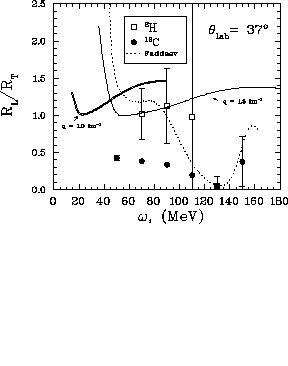 , primarily due to
the low pion mass. Several experiments including both
, primarily due to
the low pion mass. Several experiments including both
 scattering [Car84] and
 scattering [Lut93] [Che93] [Tad94]
were conducted at the Los Alamos Meson Physics Facility (LAMPF) with
scattering [Lut93] [Che93] [Tad94]
were conducted at the Los Alamos Meson Physics Facility (LAMPF) with
 MeV to investigate this phenomenon. No evidence for the
predicted enhancement in the ratio of spin longitudinal to spin transverse
responses was found. The lack of enhancement generated a good deal of
theoretical work including different techniques for making ``exact''
calculations of the responses of light nuclei [Glo96] [Wit96]
[Pan94]. Motivated by the new theoretical work, this thesis presents
the results of measurements made on
MeV to investigate this phenomenon. No evidence for the
predicted enhancement in the ratio of spin longitudinal to spin transverse
responses was found. The lack of enhancement generated a good deal of
theoretical work including different techniques for making ``exact''
calculations of the responses of light nuclei [Glo96] [Wit96]
[Pan94]. Motivated by the new theoretical work, this thesis presents
the results of measurements made on
 and
and  quasifree reaction at the Indiana University Cyclotron Facility (IUCF) with
 MeV.
MeV.
The primary interest in this experiment was in the deuterium results
because light nuclei were the subject of both the Faddeev calculations
[Wit96] and the Green's function Monte Carlo calculations
[Pan94]. The laboratory frame spin observables ( 's) are, for
the most part, consistent with the results of Faddeev calculations at all
three angles reported
(
's) are, for
the most part, consistent with the results of Faddeev calculations at all
three angles reported
( ) with the obvious
exceptions
) with the obvious
exceptions  at
at  and
and  (figures
 and ).
The individual
and ).
The individual  's
were not reported in [Pan94].
The center-of-mass
spin observables (
's
were not reported in [Pan94].
The center-of-mass
spin observables ( 's), calculated using the laboratory frame spin
observables, did not agree as well with Faddeev results.
Generally, the
's), calculated using the laboratory frame spin
observables, did not agree as well with Faddeev results.
Generally, the  's are in qualitative agreement with the predicted
Faddeev curves, but in several
case the deuterium data seem to be more in agreement with the values
expected from free np scattering, calculated using the Argonne potential
[WSA84].
's are in qualitative agreement with the predicted
Faddeev curves, but in several
case the deuterium data seem to be more in agreement with the values
expected from free np scattering, calculated using the Argonne potential
[WSA84].
The final goal of these experiments was to obtain the ratio of the spin
longitudinal  isospin nuclear response to the spin
transverse
isospin nuclear response to the spin
transverse  isospin
nuclear response (
isospin
nuclear response ( ). These results are shown in figure
for
). These results are shown in figure
for  and in figure
for
and in figure
for  and are compared with
predictions made using the Green's function Monte Carlo calculations
and the Faddeev calculations. In the
and are compared with
predictions made using the Green's function Monte Carlo calculations
and the Faddeev calculations. In the
 case the [Pan94] calculations do a
better job of predicting experimental results. However, direct
comparison is not possible at this time because the [Pan94]
calculations are done at constant momentum transfer whereas the experiment
was done at a constant scattering angle.
At
case the [Pan94] calculations do a
better job of predicting experimental results. However, direct
comparison is not possible at this time because the [Pan94]
calculations are done at constant momentum transfer whereas the experiment
was done at a constant scattering angle.
At  the momentum transfer for these data will
be around
the momentum transfer for these data will
be around  fm
fm , so the data would be expected to fall
between the two
curves presented, which they do. In addition the deuterium data are
consistent with the prediction by Pandharipande et al. in that any
enhancement in
, so the data would be expected to fall
between the two
curves presented, which they do. In addition the deuterium data are
consistent with the prediction by Pandharipande et al. in that any
enhancement in  is pushed out to higher excitation energies in
the tail of the quasifree distribution although statistical uncertainties
prevent an unambiguous conclusion. The agreement of the data with the
[Pan94] calculations is, perhaps, a little surprising since those
calculations do not include any distortions. In fact, if the inclusion of
distortions has the same effect on
is pushed out to higher excitation energies in
the tail of the quasifree distribution although statistical uncertainties
prevent an unambiguous conclusion. The agreement of the data with the
[Pan94] calculations is, perhaps, a little surprising since those
calculations do not include any distortions. In fact, if the inclusion of
distortions has the same effect on  as it did in the RPA
calculations (
as it did in the RPA
calculations ( suppressed compared to
  [IcK92]) then the
curves given by the GFMC calculations
will move in the direction which may improve the agreement. By what amount
the curves will move, if at all, is currently impossible to say.
These results may indicate
that, as predicted, even the
[IcK92]) then the
curves given by the GFMC calculations
will move in the direction which may improve the agreement. By what amount
the curves will move, if at all, is currently impossible to say.
These results may indicate
that, as predicted, even the  is subject to the effects of
two-body mechanisms in which the transferred momentum, q, is shared by
two nucleons. It has been suggested that such processes are responsible for
measurements of enhancement in the transverse channel [Pro96] which
could mask any enhancement in the longitudinal channel. This
interpretation would be consistent with measurements of the spin transverse
response in quasifree electron scattering [CaS92].
is subject to the effects of
two-body mechanisms in which the transferred momentum, q, is shared by
two nucleons. It has been suggested that such processes are responsible for
measurements of enhancement in the transverse channel [Pro96] which
could mask any enhancement in the longitudinal channel. This
interpretation would be consistent with measurements of the spin transverse
response in quasifree electron scattering [CaS92].
The most interesting feature of the
 data is that they clearly indicate that the [Pan94]
predictions could potentially do a much better job of representing the data
than do the Faddeev
calculations. While the Faddeev calculations consistently do a good job of
predicting
data is that they clearly indicate that the [Pan94]
predictions could potentially do a much better job of representing the data
than do the Faddeev
calculations. While the Faddeev calculations consistently do a good job of
predicting  cross sections [And96] and some of the spin
observables they seem to do a worse job of predicting the overall nuclear
spin response in charge exchange reactions.
cross sections [And96] and some of the spin
observables they seem to do a worse job of predicting the overall nuclear
spin response in charge exchange reactions.
The measurement of  using the spin observable from the other
transverse direction
using the spin observable from the other
transverse direction  is complicated by the fact
that it is coupled to the spin-0 response, but these results are shown in
figure
. Due to the calculational difficulties the results
are more
uncertain, but they are still consistent with the results in figure
. However, in this case the data do not provide a
differentiation of the models.
is complicated by the fact
that it is coupled to the spin-0 response, but these results are shown in
figure
. Due to the calculational difficulties the results
are more
uncertain, but they are still consistent with the results in figure
. However, in this case the data do not provide a
differentiation of the models.
The deuterium longitudinal to transverse response ratios measured at
 are
consistent with both the [Pan94] results and the Faddeev results.
In this case the momentum transfer of the data is about
are
consistent with both the [Pan94] results and the Faddeev results.
In this case the momentum transfer of the data is about
 fm
fm . However, the large uncertainties for the
  case make it impossible for one to differentiate between the models.
While the primary focus of this work is to determine the response ratio
from the deuterium charge exchange reaction, it is worth mentioning that
the carbon results are consistent with previous work.  was
previously measured
in a quasifree charge exchange reaction on carbon at
was
previously measured
in a quasifree charge exchange reaction on carbon at  MeV,
and the results, reported in [Tad94] are reproduced in
figure . The data were collected at momentum transfers of
MeV,
and the results, reported in [Tad94] are reproduced in
figure . The data were collected at momentum transfers of
 fm
fm (
( ),
),
 fm
fm (
( ), and
 fm
fm (
( ).
The [Tad94] results show that
).
The [Tad94] results show that  for the lower momentum
transfers at
for the lower momentum
transfers at  and
and  are approximately unity and,
perhaps, falling in the tail region around
are approximately unity and,
perhaps, falling in the tail region around  fm
fm . A similar
trend can be seen in the
. A similar
trend can be seen in the  carbon data from this experiment for
which
carbon data from this experiment for
which  fm
fm . At
. At  (
( fm
fm )
)  has dropped to
  in the
peak region which also seems to have happened in the [Tad94] data by
the time the momentum transfer is
in the
peak region which also seems to have happened in the [Tad94] data by
the time the momentum transfer is  fm
fm (
( ).
Therefore, at least qualitatively the carbon data agree with previous work
done at 500 MeV. In fact, the current data perhaps indicate that the
response ratio in carbon is falling more quickly at
).
Therefore, at least qualitatively the carbon data agree with previous work
done at 500 MeV. In fact, the current data perhaps indicate that the
response ratio in carbon is falling more quickly at  MeV as a
function of momentum transfer than at
MeV as a
function of momentum transfer than at  MeV.
MeV.
Along the same lines, some comparison can be made between the  data collected at
  and those reported on here at
 . Spin-observable data from [Lut93], taken at
 at LAMPF, has been used to
calculate
at LAMPF, has been used to
calculate  and this has been compared to the
  data from
this experiment in figure .
data from
this experiment in figure .

Figure: A comparison of  as a function of energy loss between two
different experiments.
as a function of energy loss between two
different experiments.  ,
,  data are
shown in open squares, and
data are
shown in open squares, and  ,
,  data
(from LAMPF) are shown with closed squares.
data
(from LAMPF) are shown with closed squares.
These data do not use the Argonne potential to calculate the free response
since that model is only valid up to 350 MeV. Rather the Bugg and Bryan
phase shifts [BuB91] were used to extract the nuclear responses for
both sets of data.
The data aren't precisely comparable since the IUCF data has a momentum
transfer range from 1.32 fm to 1.43 fm
 and the LAMPF data
goes from 1.18 fm
and the LAMPF data
goes from 1.18 fm to 1.23 fm
 . However, these ranges are
close and it is, therefore, reassuring that the results seem consistent
within the uncertainties.
. However, these ranges are
close and it is, therefore, reassuring that the results seem consistent
within the uncertainties.
In light of the results from the deuterium data, it would now be
interesting to see more complete
calculations done using the Green's function Monte Carlo
techniques that would reflect data taken at a constant scattering angle as
well as predictions for the individual spin observables and the possible
inclusion of distortions. These data indicate that this technique is a
potentially useful method for calculating the spin-isospin
responses of light nuclei excited by hadronic probes. However, the
large uncertainty associated with measurement of the deuterium responses
makes it impossible to use these results to constrain the model any
further.
Currently data are being analyzed from the
 quasifree reaction and, if the predictions
in [Pan94] prove correct, the enhancement of
quasifree reaction and, if the predictions
in [Pan94] prove correct, the enhancement of 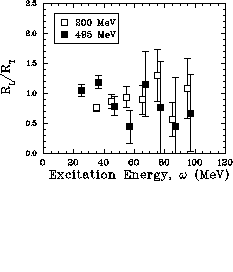 in the tail
of the distribution should be even more pronounced. Additionally,
[Pan94] also makes predictions for the
in the tail
of the distribution should be even more pronounced. Additionally,
[Pan94] also makes predictions for the  quasifree
charge-exchange reaction, which is currently an approved experiment at IUCF
awaiting beam time. If these other experiments also support the
conclusions of Pandharipande et al., it would be exciting to see if
their calculational techniques can in the future be extended to heavier
targets, such as carbon, and give insight into the persistent question
of the effect of the nuclear medium on the NN interaction.
quasifree
charge-exchange reaction, which is currently an approved experiment at IUCF
awaiting beam time. If these other experiments also support the
conclusions of Pandharipande et al., it would be exciting to see if
their calculational techniques can in the future be extended to heavier
targets, such as carbon, and give insight into the persistent question
of the effect of the nuclear medium on the NN interaction.