


The  spin-observables presented in this section were extracted
from the quasifree scattering data taken during experiments E385 and E387.
The quasifree region was split into 10 MeV bins which seemed to provide
reasonable statistics to extract the observables while still providing a
good picture of the energy dependence. The results from the data taken
with the normally polarized
spin-observables presented in this section were extracted
from the quasifree scattering data taken during experiments E385 and E387.
The quasifree region was split into 10 MeV bins which seemed to provide
reasonable statistics to extract the observables while still providing a
good picture of the energy dependence. The results from the data taken
with the normally polarized  beam, which includes
 ,
, 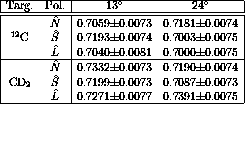 , and P (induced polarization), are listed on
tables
, and P (induced polarization), are listed on
tables  and for
  and
and
 , respectively.

Table: Spin-observable results from the
 reaction at
  for an
  polarized proton beam with
  MeV.
MeV.

Table: Spin-observable results from the
 reaction at
 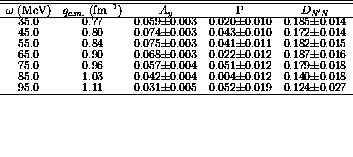 for an
  polarized proton beam with
  MeV.
MeV.
These results are shown in graphical format in figure compared to
results from recent Faddeev type calculations [Wit96] of the deuterium
observables. The analyzing power and
induced polarization seem to be in reasonable agreement. Both show
rather small magnitudes. However, in  there is significant
disagreement between the
there is significant
disagreement between the  data and both the Faddeev calculations
and the
data and both the Faddeev calculations
and the  data.
data.

Figure: Spin-observable results from the
 and
and  reactions at
  for an
  polarized proton beam with
  MeV. The
excitation spectra are shown at the top. The dashed line show the results
of Faddeev calculations of the spin-observables for the deuterium
reaction. The vertical dotted line indicate the energy loss for free np
scattering.
MeV. The
excitation spectra are shown at the top. The dashed line show the results
of Faddeev calculations of the spin-observables for the deuterium
reaction. The vertical dotted line indicate the energy loss for free np
scattering.
The results for the sideways and longitudinal incident beams for the
 reaction are compiled in tables
and , respectively. Similarly, the
spin-observables from the
reaction are compiled in tables
and , respectively. Similarly, the
spin-observables from the  are shown in
tables and for the sideways and
longitudinally polarized beams, respectively.
are shown in
tables and for the sideways and
longitudinally polarized beams, respectively.

Table: Spin-observable results from the
 reaction at
  for an
  polarized proton beam with
  MeV.
MeV.

Table: Spin-observable results from the
 reaction at
 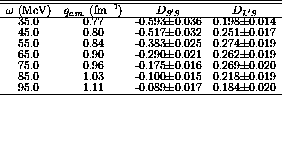 for an
  polarized proton beam with
  MeV.
MeV.

Table: Spin-observable results from the
 reaction at
 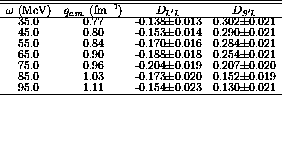 for an
  polarized proton beam with
  MeV.
MeV.

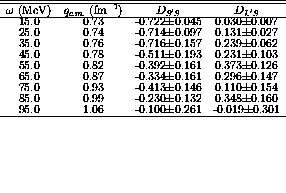
Table: Spin-observable results from the
 reaction at
  for an
  polarized proton beam with
  MeV.
MeV.
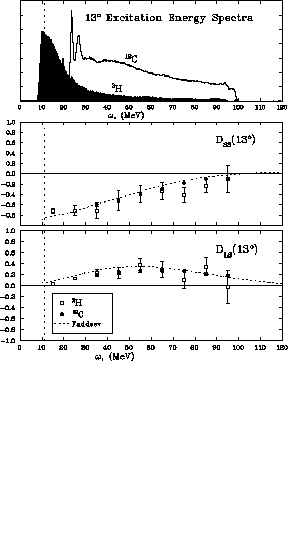
The results from the sideways and longitudinal data are also shown in
figures and , respectively. Generally, it seems that
the Faddeev calculations predict the  results fairly well for
all the in-plane spin observables with possible exception of
results fairly well for
all the in-plane spin observables with possible exception of
 . The
. The  and
and  results also seem to
follow the same trends.
results also seem to
follow the same trends.

Figure: Spin-observable results from the
 and
and  reactions at
  for an
  polarized proton beam with
  MeV. The
excitation spectra are shown at the top. The dashed line show the results
of Faddeev calculations of the spin-observables for the deuterium
reaction. The vertical dotted line indicate the energy loss for free np
scattering.
MeV. The
excitation spectra are shown at the top. The dashed line show the results
of Faddeev calculations of the spin-observables for the deuterium
reaction. The vertical dotted line indicate the energy loss for free np
scattering.

Figure: Spin-observable results from the
 and
and  reactions at
  for an
  polarized proton beam with
  MeV. The
excitation spectra are shown at the top. The dashed line show the results
of Faddeev calculations of the spin-observables for the deuterium
reaction. The vertical dotted line indicate the energy loss for free np
scattering.
MeV. The
excitation spectra are shown at the top. The dashed line show the results
of Faddeev calculations of the spin-observables for the deuterium
reaction. The vertical dotted line indicate the energy loss for free np
scattering.
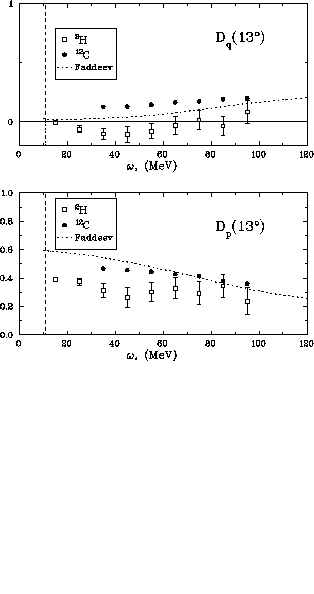
The center-of-mass spin observables,  's, are shown in figures
and . These results are also compared to the
results of Faddeev calculations (shown with the dashed line).
's, are shown in figures
and . These results are also compared to the
results of Faddeev calculations (shown with the dashed line).

Figure: 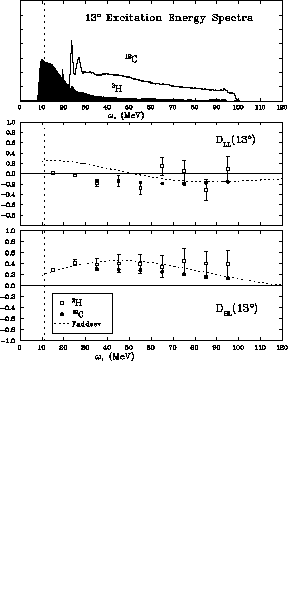 (spin 0) and
  (spin transverse,
 )
spin observables as a function of energy loss at
)
spin observables as a function of energy loss at
 .
Results from both deuterium and carbon are shown. The short-dashed line
are the results of Faddeev calculations of the deuterium spin observables.
The long-dashed line shows the free np scattering results based on the
Argonne potential.
The vertical dotted line indicates the energy loss for free np scattering.
.
Results from both deuterium and carbon are shown. The short-dashed line
are the results of Faddeev calculations of the deuterium spin observables.
The long-dashed line shows the free np scattering results based on the
Argonne potential.
The vertical dotted line indicates the energy loss for free np scattering.

Figure: 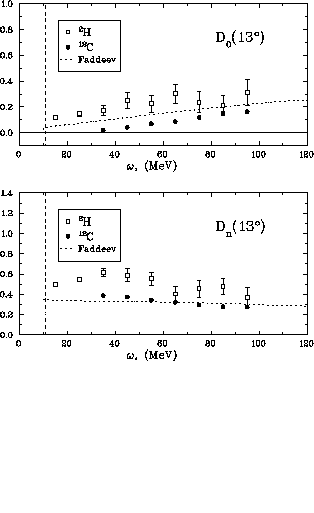 (spin longitudinal,
  ) and
) and  (spin transverse,
  )
spin observables as a function of energy loss at
)
spin observables as a function of energy loss at
 .
Results from both deuterium and carbon are shown. The short-dashed line
are the results of Faddeev calculations of the deuterium spin observables.
The long-dashed line shows the free np scattering results based on the
Argonne potential.
The vertical dotted line indicates the energy loss for free np scattering.
.
Results from both deuterium and carbon are shown. The short-dashed line
are the results of Faddeev calculations of the deuterium spin observables.
The long-dashed line shows the free np scattering results based on the
Argonne potential.
The vertical dotted line indicates the energy loss for free np scattering.
The  results have been presented for completeness but it is
unclear if any conclusions regarding quasifree scattering can be drawn
from them. The range of energy
loss over which data was gathered, as shown at the top of figure
for example, spans a momentum transfer of
results have been presented for completeness but it is
unclear if any conclusions regarding quasifree scattering can be drawn
from them. The range of energy
loss over which data was gathered, as shown at the top of figure
for example, spans a momentum transfer of  fm
fm to
to
 fm
fm . In this range quasifree scattering is just
beginning
to turn on. That is, the momentum transferred to the stationary nucleon in
the nucleus is barely sufficient for knock-out, which defines quasifree
scattering. Also, in this region of momentum transfer measured at
. In this range quasifree scattering is just
beginning
to turn on. That is, the momentum transferred to the stationary nucleon in
the nucleus is barely sufficient for knock-out, which defines quasifree
scattering. Also, in this region of momentum transfer measured at
 the pion effects are going to be very small.
From figure one can see that the expected longitudinal
contribution from the pion is around zero. This supported by the fact that
the longitudinal spin observable
the pion effects are going to be very small.
From figure one can see that the expected longitudinal
contribution from the pion is around zero. This supported by the fact that
the longitudinal spin observable  is essentially zero in figure
. To look for a change in nuclear response functions due to an
enhanced pion field it is reasonable to look other momentum transfers where
the pion residual interaction in non-zero.
is essentially zero in figure
. To look for a change in nuclear response functions due to an
enhanced pion field it is reasonable to look other momentum transfers where
the pion residual interaction in non-zero.
It is worth mentioning at this point that data were taken at  primarily because
  was considered to be a possibly interesting
angle. That meant that the INPOL detector had to gather
was considered to be a possibly interesting
angle. That meant that the INPOL detector had to gather  data
while the KSU detector gathered data at
data
while the KSU detector gathered data at  .
.