


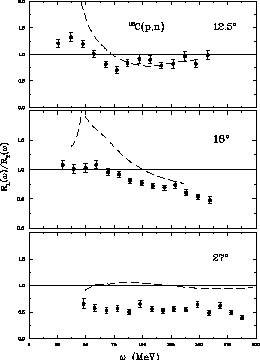
Several different groups have attempted, by various means, to explain
the failure of
the theory to describe the experimental data. One group
[Ich89] extends the calculations of Alberico, et al.
[AEM82] by
adding distortions of the trajectory and spin orientation in the nuclear
potential to the incident and ejected nucleon wave-functions. Another
method [HoP93] [HiD94] used the plane wave approximation (no
distortions) but incorporates relativistic effects by treating the nucleons
as full Dirac particles. Yet another explanation [BrR91] [BrW94]
comes from the possible rescaling of the  meson mass inside the
nuclear medium, which would mask the enhancement of the spin-longitudinal
to spin-transverse ratio. Each of these explanations will be described in
more detail in chapter
meson mass inside the
nuclear medium, which would mask the enhancement of the spin-longitudinal
to spin-transverse ratio. Each of these explanations will be described in
more detail in chapter  . The attempt to gather further
experimental data
to evaluate these theories is the primary motivation behind the measurement
of polarization observables in
. The attempt to gather further
experimental data
to evaluate these theories is the primary motivation behind the measurement
of polarization observables in  C presented in this thesis.
Even more recently Pandharipande et al. made a set of ``exact''
calculations
of the spin responses of light nuclei ( H,
H,  He, and
  He) using a
variational Green's Function
Monte Carlo technique [Pan94]. This method allowed the calculation of
the spin responses without using the random phase approximation used in the
original calculations by Alberico et al. [AEM82] and in the
methods described in
the preceding paragraph. The results of these calculations predict an
enhancement, but it is pushed to higher energy loss than previously
thought. This method will also be described in more detail in chapter
.
These calculations, using conventional nuclear potentials, predict a
measurable enhancement even in
He) using a
variational Green's Function
Monte Carlo technique [Pan94]. This method allowed the calculation of
the spin responses without using the random phase approximation used in the
original calculations by Alberico et al. [AEM82] and in the
methods described in
the preceding paragraph. The results of these calculations predict an
enhancement, but it is pushed to higher energy loss than previously
thought. This method will also be described in more detail in chapter
.
These calculations, using conventional nuclear potentials, predict a
measurable enhancement even in
 H and significant enhancements in
  He and
  He. This is the
primary motivation behind the measurement of the polarization observables in
He. This is the
primary motivation behind the measurement of the polarization observables in
 H reported on in this thesis.
Chapter will present the theoretical background for the
various
predictions made of the nuclear responses in quasifree
 scattering. Chapter will introduce the
theoretical formalism in which the data for the current experiment will be
presented and discussed. Chapter will detail the experimental
apparatus
used to make the measurements and Chapter will present the
methods used
for reducing the raw data to the desired polarization observables and
nuclear responses. In Chapter the results of the
experiments will be
presented including a comparison of the data with theoretical models.
Chapter will summarize the conclusions from the experiment.
scattering. Chapter will introduce the
theoretical formalism in which the data for the current experiment will be
presented and discussed. Chapter will detail the experimental
apparatus
used to make the measurements and Chapter will present the
methods used
for reducing the raw data to the desired polarization observables and
nuclear responses. In Chapter the results of the
experiments will be
presented including a comparison of the data with theoretical models.
Chapter will summarize the conclusions from the experiment.