


As mentioned above, an orientation angle phi is calculated
for each hit found. We also assume the track is primary, and
trivially obtain  . From this, we use an empirical
formula to extract the crossing angle
. From this, we use an empirical
formula to extract the crossing angle  .
.
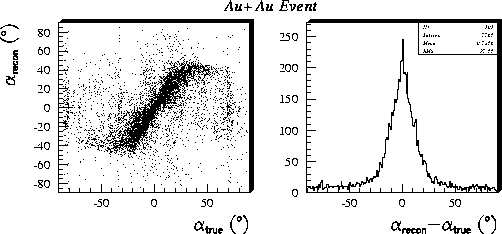
Figure 29: Crossing angle  as calculated by hitfinder based on
cluster shape is compared with the true crossing angle generated.
as calculated by hitfinder based on
cluster shape is compared with the true crossing angle generated.
We find reasonable correspondance between the calculated
crossing angle and the true one, on average, as shown in
Figure 29 for a Au+Au event.
However, the dispersion
about this average is large. The
crossing angle  found by the cluster/hitfinder may
be useful to the tracking software in some cases, but
clearly a better resolution in the determination of
found by the cluster/hitfinder may
be useful to the tracking software in some cases, but
clearly a better resolution in the determination of  would
be desirable. Our understanding of the
relationship between the hit pattern shape and the crossing angles
is obviously incomplete, and this issue remains a topic for further study.
would
be desirable. Our understanding of the
relationship between the hit pattern shape and the crossing angles
is obviously incomplete, and this issue remains a topic for further study.