


The orientation of the pixel pattern corresponding to a hit
is also calculated. Shown in Figure
14 is a single-hit cluster pattern which
is skewed due to large track crossing angles  and
and  .
The angle of the pattern with respect to the padrow (indicated by the
overlaid line in the figure) is correlated with these crossing angles.
This angle is stored in TPHIT.PHI. What should be
relevant to tracking algorithms
is an estimate of the crossing angles
.
The angle of the pattern with respect to the padrow (indicated by the
overlaid line in the figure) is correlated with these crossing angles.
This angle is stored in TPHIT.PHI. What should be
relevant to tracking algorithms
is an estimate of the crossing angles  and
and  .
As intuitively expected, the angles
.
As intuitively expected, the angles  ,
,
 , and
, and  are observed to be correlated, so that
knowledge of two of them gives the third. For tracks originating
from the center of the TPC,
are observed to be correlated, so that
knowledge of two of them gives the third. For tracks originating
from the center of the TPC,  = Tan
= Tan ,
where r is the radial distance of the hit
and z is the seperation along the TPC axis between the hit
and the central E-field membrane. TPH stores this
value into TPHIT.LAMBDA.
,
where r is the radial distance of the hit
and z is the seperation along the TPC axis between the hit
and the central E-field membrane. TPH stores this
value into TPHIT.LAMBDA.
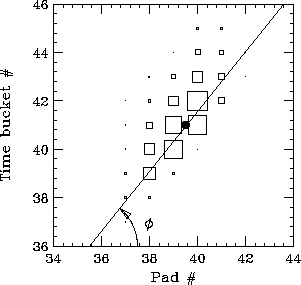
Figure 14: The position and orientation of a hit in a single-hit cluster
are shown. The large skew (non-zero orientation) of the pattern arises
from large track crossing angles.
Given  and
and  ,
we should be able to estimate the crossing angle
,
we should be able to estimate the crossing angle  .
If we use local coordinates such that x is along the padrow (in
the ``pad direction''), y is perpendicular to the padrows, and
z is along the drift direction, then the two crossing angles
are given by
.
If we use local coordinates such that x is along the padrow (in
the ``pad direction''), y is perpendicular to the padrows, and
z is along the drift direction, then the two crossing angles
are given by


whereas our calculated ``orientation angle''  might be
expected to be written
might be
expected to be written

which would lead one to conclude that alpha could be calculated by
However, the orientation angle  is more complicated, and we find that
an empirical relation is needed.
is more complicated, and we find that
an empirical relation is needed.
In the simulations we find that there are
strong correlations of  with our assumed
  and
our calculated
and
our calculated  .
Two branches in the relation of the true
.
Two branches in the relation of the true  vs
vs  (as given by Equation 19) are seen, and neither one
is linear.
(as given by Equation 19) are seen, and neither one
is linear.
Experimenting with different parametrizations leads to a relation

The resolution for reconstructing the crossing
angle  is only fair
(see Section 6.4
below).
However, this hit-by-hit estimate of the
track crossing angle, which intrinsically involves the third dimension
(perpendicular to the padrow), based on the two-dimensional pad-tdc space,
may still be useful to the tracking software in situations in which it
is not clear to which track a hit belongs.
is only fair
(see Section 6.4
below).
However, this hit-by-hit estimate of the
track crossing angle, which intrinsically involves the third dimension
(perpendicular to the padrow), based on the two-dimensional pad-tdc space,
may still be useful to the tracking software in situations in which it
is not clear to which track a hit belongs.
