


The final important cut to be made on the data is a cut on the velocity
ratio, or  .
.  is the ratio of the velocity of the particle
deduced from the time of flight between the analyzer and the catcher
is the ratio of the velocity of the particle
deduced from the time of flight between the analyzer and the catcher
 and the velocity expected based on the time-of-flight to the
first plane
and the velocity expected based on the time-of-flight to the
first plane 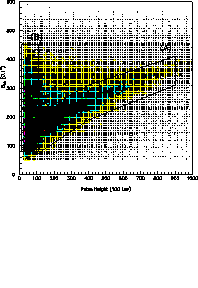 .
.  is simply defined as

where d is the distance between the analyzer and the catcher planes, and
 and
and  are the respective times of hits in the analyzer and
catcher planes.
are the respective times of hits in the analyzer and
catcher planes.  is calculated from nn relativistic kinematics
using the neutron energy,
is calculated from nn relativistic kinematics
using the neutron energy,  , which has been determined from the
time-of-flight of the neutron to the analyzer plane:
, which has been determined from the
time-of-flight of the neutron to the analyzer plane:

where  is 939.57 MeV, and
  is the polar scattering angle.
The velocity ratio is then simply
is the polar scattering angle.
The velocity ratio is then simply

For a  event the velocity ratio should be unity. Figure
 shows a typical velocity ratio histogram.

Figure: Velocity ratio histogram. The dashed line represents 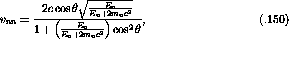 where the observed interplane velocity equals the expected velocity.
As would be expected, and is obvious from figure , the
resolution on the interplane velocity is not very good. However, this cut
can still help remove a number of bad events. Any events with the wrong
plane hit sequence, such as stray neutrons or cosmic rays travelling the
wrong direction through the detector, will be cut out.
 events will be cut out because the Q value of
these
events will be cut out because the Q value of
these  reactions will slow the outgoing neutrons compared to
those free scattered off the protons in the scintillator. Also,
reactions will slow the outgoing neutrons compared to
those free scattered off the protons in the scintillator. Also,
 events are cut because the
  velocity is
much greater than expected for a neutron. The last significant form of
event that the velocity ratio cut helps to clean up is wrap-around
neutrons. These very slow neutrons generated by a previous beam pulse
could arrive at
the analyzer plane at the same time as the faster neutrons from the pulse
being measured, which would dilute the results. However, the subsequent
requirement of substantiated interplane velocity will get rid of those
slow neutrons and significantly reduce the background.
velocity is
much greater than expected for a neutron. The last significant form of
event that the velocity ratio cut helps to clean up is wrap-around
neutrons. These very slow neutrons generated by a previous beam pulse
could arrive at
the analyzer plane at the same time as the faster neutrons from the pulse
being measured, which would dilute the results. However, the subsequent
requirement of substantiated interplane velocity will get rid of those
slow neutrons and significantly reduce the background.
It is obvious from the continuum seen in figure
that it is impossible to completely separate the np elastic
scattering events from other, less useful events. Attempts to model the
analyzing power as a sum of the contributions of all possible reactions
have proven quite difficult, and this is why  is measured
empirically. The
is measured
empirically. The 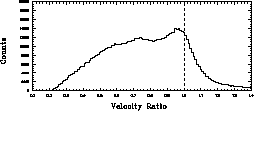 of any polarimeter of this type will fall short
of the expectations of free np elastic scattering (see figure
), but that will not
invalidate the measurement of the polarimeter's analyzing power nor
compromise its ability to measure neutron polarization.
of any polarimeter of this type will fall short
of the expectations of free np elastic scattering (see figure
), but that will not
invalidate the measurement of the polarimeter's analyzing power nor
compromise its ability to measure neutron polarization.