


The final offset which must be determined is the overall, or global, RF
offset which determines the time-of-flight of the neutrons to the first
plane. Obviously this offset is critical since this time-of-flight will
determine the energy of the neutrons detected in the polarimeter. The
gamma peak described above is also used for this calibration. Figure
 shows a raw time-of-flight spectrum for a
  target at
  .
.

Figure: Raw time-of-flight spectrum for the  at a scattering
angle of
at a scattering
angle of 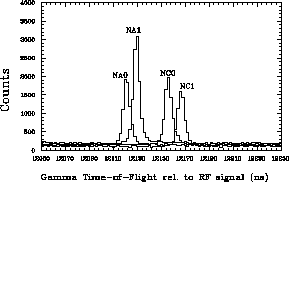 . The gamma peak, caused by pion
production and decay in the target, is labelled.
. The gamma peak, caused by pion
production and decay in the target, is labelled.
It has been determined that, given the flight path of 160 meters, the
gamma peak in the front plane should be centered on channel 12136 in the
TOF histogram shown in figure . Therefore, as a final step to
the calibration the global RF offset is adjusted in software to bring the
gamma peak to the correct position. This calibration is done for every run
in order to correct for slight shifts in the timing of the beam or the
phase of the corrected RF signal.
A more detailed discussion of the calibration techniques used in the data replay for these types of detectors can be found in [Tad85].