


 energy spectrum showing the position of the
quasifree
peak. The spectrum was taken at
energy spectrum showing the position of the
quasifree
peak. The spectrum was taken at 
 and
and  MeV. The cutoff at 100 MeV is
an artifact of the experiment.
MeV. The cutoff at 100 MeV is
an artifact of the experiment.
 at q = 1.75
 and
and  = 500 MeV.
The dashed
line shows the Alberico et al. calculations [AEM82]
at full nuclear density;
the dotted line, at half nuclear density. [Car84]
= 500 MeV.
The dashed
line shows the Alberico et al. calculations [AEM82]
at full nuclear density;
the dotted line, at half nuclear density. [Car84]
 at 494 MeV. The dashed lines show
results from full RPA + DWIA calculations. [Tad94].
at 494 MeV. The dashed lines show
results from full RPA + DWIA calculations. [Tad94].
 and
and 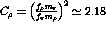 meson exchange. The
dashed line shows the
meson exchange. The
dashed line shows the  dependence and the
dotted line shows the
dependence and the
dotted line shows the  dependence of the interaction. [Pro91]
 meson mass as a function of density
  ;
based on QCD sum rule calculations. Functional form is
;
based on QCD sum rule calculations. Functional form is
 , where
 . The deviation from linearity is the result of an
uncertainty in the calculation [HaL92].
. The deviation from linearity is the result of an
uncertainty in the calculation [HaL92].
 facility target.
 '' polarimeter: a) Isometric view, b) Side view
[Wat94].
'' polarimeter: a) Isometric view, b) Side view
[Wat94].
 MeV. Maximum FOM is at
  [Wat94].
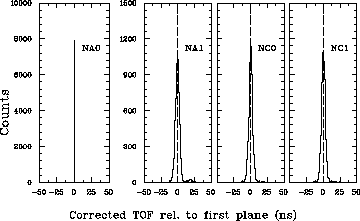
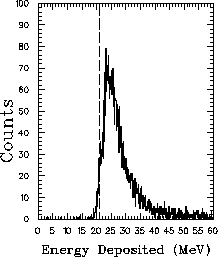 ns indicate the offsets are set
correctly.
ns indicate the offsets are set
correctly.
 at a scattering
angle of
at a scattering
angle of 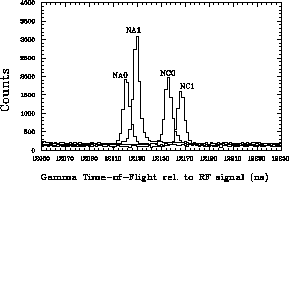 . The gamma peak, caused by pion
production and decay in the target, is labelled.
. The gamma peak, caused by pion
production and decay in the target, is labelled.
 plane used
for categorizing the direction of neutron scattering.
plane used
for categorizing the direction of neutron scattering.
 IAS reaction. The crosses are the
results of calculations based on free n-p scattering. The asterisks are
the calculated values reduced by a factor of 0.85 [Tad85].
IAS reaction. The crosses are the
results of calculations based on free n-p scattering. The asterisks are
the calculated values reduced by a factor of 0.85 [Tad85].
 spectrum. The
 ground state is the most prominent feature. The smaller
peaks at lower neutron energy are the result of beam contamination of the
type discussed in section 4.1.3. The peak at the higher neutron
energy than the ground state is the result of
ground state is the most prominent feature. The smaller
peaks at lower neutron energy are the result of beam contamination of the
type discussed in section 4.1.3. The peak at the higher neutron
energy than the ground state is the result of  contamination
in the target.
contamination
in the target.
 distribution of double-scattering events in
the polarimeter.
distribution of double-scattering events in
the polarimeter.  is defined as a horizontal scatter to the left.
The spikes are the result of finite size of the detector cells.
is defined as a horizontal scatter to the left.
The spikes are the result of finite size of the detector cells.
 distributions in the
  state and
the
state and
the  state for a single sample run. The dotted line is the actual
difference in the data and the solid line is a smooth spline fit to that
difference.
state for a single sample run. The dotted line is the actual
difference in the data and the solid line is a smooth spline fit to that
difference.
 ,
distribution in the polarimeter. The spikes are the result of the limited
position resolution of the detector cells.
,
distribution in the polarimeter. The spikes are the result of the limited
position resolution of the detector cells.
 reaction [Arn96].
 is shown in the angular direction and
  in the
radial direction. Relative height indicates the event count.
in the
radial direction. Relative height indicates the event count.
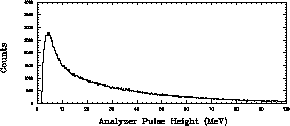 , versus the analyzer pulse
height. The branch labelled (A) are primarily the
, versus the analyzer pulse
height. The branch labelled (A) are primarily the  events
while those in the box marked (B) are
events
while those in the box marked (B) are  events,
cosmic ray events, and others that deposit very little energy.
events,
cosmic ray events, and others that deposit very little energy.
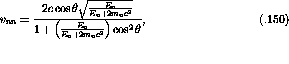 where the observed interplane velocity equals the expected velocity.
 .
.  is the lower gate, and
  is
the upper gate. The top plot shows the effective analyzing power,
is
the upper gate. The top plot shows the effective analyzing power,
 , and the lower plot shows figure-of-merit (FOM).
 energy spectrum from the
  reaction at
  . The
. The  (4.15 MeV) state is
labelled.
(4.15 MeV) state is
labelled.
 ,
,  and
and
 spectra at
  . The deuterium spectra was obtained by a
weighted subtraction of the carbon from the
. The deuterium spectra was obtained by a
weighted subtraction of the carbon from the  .
.
 and
and  reactions at
  for an
  polarized proton beam with
  MeV. The
excitation spectra are shown at the top. The dashed line show the results
of Faddeev calculations of the spin-observables for the deuterium
reaction. The vertical dotted line indicate the energy loss for free np
scattering.
MeV. The
excitation spectra are shown at the top. The dashed line show the results
of Faddeev calculations of the spin-observables for the deuterium
reaction. The vertical dotted line indicate the energy loss for free np
scattering.
 and
and  reactions at
  for an
  polarized proton beam with
  MeV. The
excitation spectra are shown at the top. The dashed line show the results
of Faddeev calculations of the spin-observables for the deuterium
reaction. The vertical dotted line indicate the energy loss for free np
scattering.
MeV. The
excitation spectra are shown at the top. The dashed line show the results
of Faddeev calculations of the spin-observables for the deuterium
reaction. The vertical dotted line indicate the energy loss for free np
scattering.
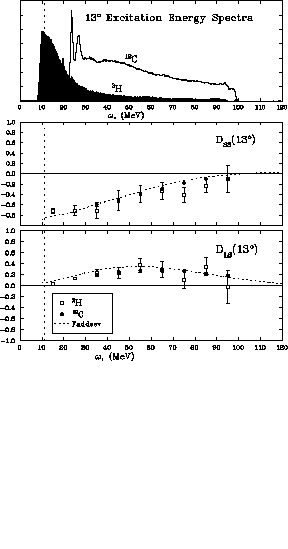 and
and  reactions at
  for an
  polarized proton beam with
  MeV. The
excitation spectra are shown at the top. The dashed line show the results
of Faddeev calculations of the spin-observables for the deuterium
reaction. The vertical dotted line indicate the energy loss for free np
scattering.
MeV. The
excitation spectra are shown at the top. The dashed line show the results
of Faddeev calculations of the spin-observables for the deuterium
reaction. The vertical dotted line indicate the energy loss for free np
scattering.
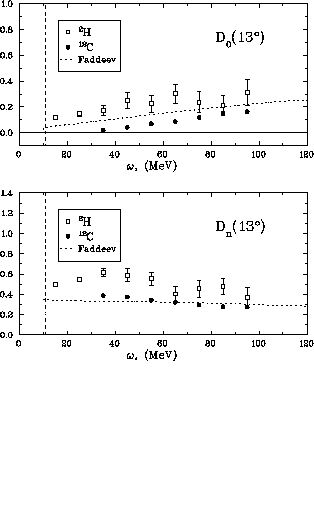
 (spin 0) and
  (spin transverse,
 )
spin observables as a function of energy loss at
)
spin observables as a function of energy loss at
 .
Results from both deuterium and carbon are shown. The short-dashed line
are the results of Faddeev calculations of the deuterium spin observables.
The long-dashed line shows the free np scattering results based on the
Argonne potential.
The vertical dotted line indicates the energy loss for free np scattering.
.
Results from both deuterium and carbon are shown. The short-dashed line
are the results of Faddeev calculations of the deuterium spin observables.
The long-dashed line shows the free np scattering results based on the
Argonne potential.
The vertical dotted line indicates the energy loss for free np scattering.
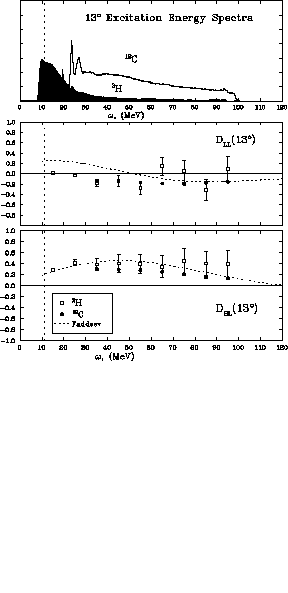
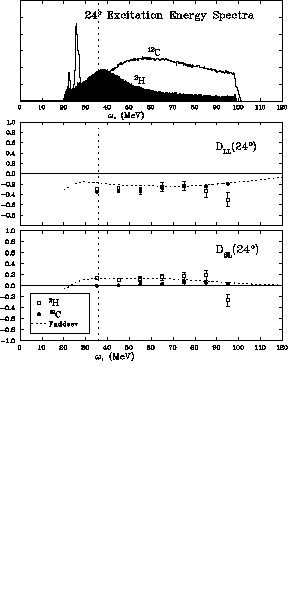
 (spin longitudinal,
  ) and
) and  (spin transverse,
  )
spin observables as a function of energy loss at
)
spin observables as a function of energy loss at
 .
Results from both deuterium and carbon are shown. The short-dashed line
are the results of Faddeev calculations of the deuterium spin observables.
The long-dashed line shows the free np scattering results based on the
Argonne potential.
The vertical dotted line indicates the energy loss for free np scattering.
.
Results from both deuterium and carbon are shown. The short-dashed line
are the results of Faddeev calculations of the deuterium spin observables.
The long-dashed line shows the free np scattering results based on the
Argonne potential.
The vertical dotted line indicates the energy loss for free np scattering.
 and
and  reactions at
  for an
  polarized proton beam with
  MeV. The
excitation spectra are shown at the top. The dashed line show the results
of Faddeev calculations of the spin-observables for the deuterium
reaction. The vertical dotted line indicate the energy loss for free np
scattering.
MeV. The
excitation spectra are shown at the top. The dashed line show the results
of Faddeev calculations of the spin-observables for the deuterium
reaction. The vertical dotted line indicate the energy loss for free np
scattering.
 and
and  reactions at
  for an
  polarized proton beam with
  MeV. The
excitation spectra are shown at the top. The dashed line show the results
of Faddeev calculations of the spin-observables for the deuterium
reaction. The vertical dotted line indicate the energy loss for free np
scattering.
MeV. The
excitation spectra are shown at the top. The dashed line show the results
of Faddeev calculations of the spin-observables for the deuterium
reaction. The vertical dotted line indicate the energy loss for free np
scattering.
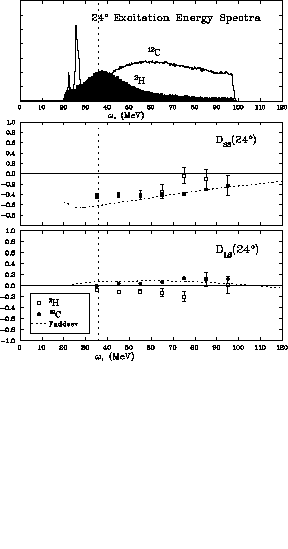 and
and  reactions at
  for an
  polarized proton beam with
  MeV. The
excitation spectra are shown at the top. The dashed line show the results
of Faddeev calculations of the spin-observables for the deuterium
reaction. The vertical dotted line indicate the energy loss for free np
scattering.
MeV. The
excitation spectra are shown at the top. The dashed line show the results
of Faddeev calculations of the spin-observables for the deuterium
reaction. The vertical dotted line indicate the energy loss for free np
scattering.
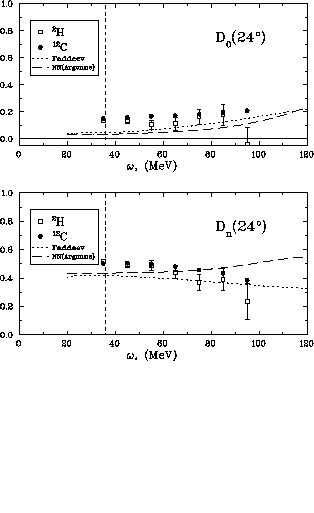
 (spin 0) and
  (spin transverse,
 )
spin observables as a function of energy loss at
)
spin observables as a function of energy loss at
 .
Results from both deuterium and carbon are shown. The short-dashed line
are the results of Faddeev calculations of the deuterium spin observables.
The long-dashed line are the free np scattering results for the Argonne
potential.
The vertical dotted line indicates the energy loss for free np scattering.
.
Results from both deuterium and carbon are shown. The short-dashed line
are the results of Faddeev calculations of the deuterium spin observables.
The long-dashed line are the free np scattering results for the Argonne
potential.
The vertical dotted line indicates the energy loss for free np scattering.
 (spin longitudinal,
  ) and
) and  (spin transverse,
  )
spin observables as a function of energy loss at
)
spin observables as a function of energy loss at  .
Results from both deuterium and carbon are shown. The short-dashed line
are the results of Faddeev calculations of the deuterium spin observables.
The long-dashed line are the free np scattering results for the
Argonne potential.
The vertical dotted line indicates the energy loss for free np scattering.
.
Results from both deuterium and carbon are shown. The short-dashed line
are the results of Faddeev calculations of the deuterium spin observables.
The long-dashed line are the free np scattering results for the
Argonne potential.
The vertical dotted line indicates the energy loss for free np scattering.
 and
and  reactions at
  for an
  polarized proton beam with
  MeV. The
excitation spectra are shown at the top. The dashed line show the results
of Faddeev calculations of the spin-observables for the deuterium
reaction. The vertical dotted line indicate the energy loss for free np
scattering.
MeV. The
excitation spectra are shown at the top. The dashed line show the results
of Faddeev calculations of the spin-observables for the deuterium
reaction. The vertical dotted line indicate the energy loss for free np
scattering.
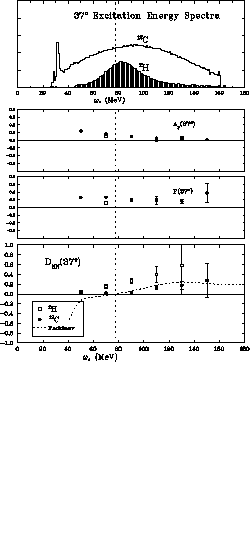 and
and  reactions at
  for an
  polarized proton beam with
  MeV. The
excitation spectra are shown at the top. The dashed line show the results
of Faddeev calculations of the spin-observables for the deuterium
reaction. The vertical dotted line indicate the energy loss for free np
scattering.
MeV. The
excitation spectra are shown at the top. The dashed line show the results
of Faddeev calculations of the spin-observables for the deuterium
reaction. The vertical dotted line indicate the energy loss for free np
scattering.
 and
and  reactions at
  for an
  polarized proton beam with
  MeV. The
excitation spectra are shown at the top. The dashed line show the results
of Faddeev calculations of the spin-observables for the deuterium
reaction. The vertical dotted line indicate the energy loss for free np
scattering.
MeV. The
excitation spectra are shown at the top. The dashed line show the results
of Faddeev calculations of the spin-observables for the deuterium
reaction. The vertical dotted line indicate the energy loss for free np
scattering.
 (spin 0) and
  (spin transverse,
 )
spin observables as a function of energy loss at
)
spin observables as a function of energy loss at
 .
Results from both deuterium and carbon are shown. The short-dashed line
shows the
results of Faddeev calculations of the deuterium spin observables. The
long-dashed line shows the free np scattering results based on the Argonne
potential.
The vertical dotted line indicates the energy loss for free np scattering.
.
Results from both deuterium and carbon are shown. The short-dashed line
shows the
results of Faddeev calculations of the deuterium spin observables. The
long-dashed line shows the free np scattering results based on the Argonne
potential.
The vertical dotted line indicates the energy loss for free np scattering.
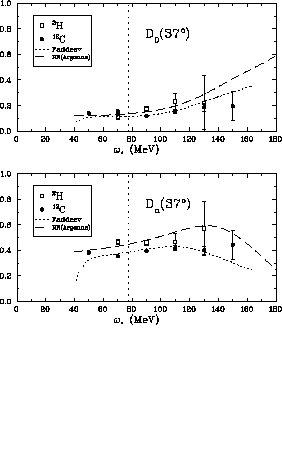 (spin longitudinal,
  ) and
) and
 (spin transverse,
  )
spin observables as a function of energy loss at
)
spin observables as a function of energy loss at  .
Results from both deuterium and carbon are shown. The short-dashed line
shows the
results of Faddeev calculations of the deuterium spin observables. The
long-dashed line shows the free np scattering results based on the Argonne
potential.
The vertical dotted line indicates the energy loss for free np scattering.
.
Results from both deuterium and carbon are shown. The short-dashed line
shows the
results of Faddeev calculations of the deuterium spin observables. The
long-dashed line shows the free np scattering results based on the Argonne
potential.
The vertical dotted line indicates the energy loss for free np scattering.
 versus energy loss for both deuterium and carbon at
 . The short-dashed line are the results from the
Faddeev calculations and the long-dashed line is the free scattering result
from the Argonne potential. The vertical dotted line indicates the energy
loss for free np scattering.
. The short-dashed line are the results from the
Faddeev calculations and the long-dashed line is the free scattering result
from the Argonne potential. The vertical dotted line indicates the energy
loss for free np scattering.
 versus energy loss for both deuterium and carbon at
 . The short-dashed line are the results from the
Faddeev calculations and the long-dashed line is the free scattering result
from the Argonne potential. The vertical dotted line indicates the energy
loss for free np scattering.
. The short-dashed line are the results from the
Faddeev calculations and the long-dashed line is the free scattering result
from the Argonne potential. The vertical dotted line indicates the energy
loss for free np scattering.
 versus energy loss showing
both the deuterium and carbon data at
versus energy loss showing
both the deuterium and carbon data at  . The
dashed line indicates the results
of Faddeev calculations. Also shown are the results from
[Pan94] at
. The
dashed line indicates the results
of Faddeev calculations. Also shown are the results from
[Pan94] at  (double line) and
 (thick solid line).
 versus energy loss showing
both the deuterium and carbon data at
versus energy loss showing
both the deuterium and carbon data at  . The
dashed line indicates the results
of Faddeev calculations. Also shown are the results from
[Pan94] at
. The
dashed line indicates the results
of Faddeev calculations. Also shown are the results from
[Pan94] at  (double line) and
 (thick solid line). The data at high energy loss
have all been binned together to improve statistics.
(thick solid line). The data at high energy loss
have all been binned together to improve statistics.
 versus energy loss showing
both the deuterium and carbon data at
versus energy loss showing
both the deuterium and carbon data at  . The
dashed line indicates the results
of Faddeev calculations. Also shown are the results from
[Pan94] at
. The
dashed line indicates the results
of Faddeev calculations. Also shown are the results from
[Pan94] at  (double line) and
 (thick solid line). The data at high energy loss
have all been binned together to improve statistics.
(thick solid line). The data at high energy loss
have all been binned together to improve statistics.
 versus energy loss for both deuterium and carbon at
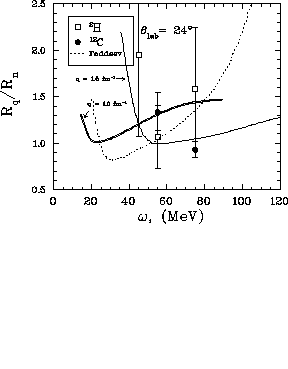 . The short-dashed line are the results from the
Faddeev calculations and the long-dashed line is the free scattering result
from the Argonne potential. The vertical dotted line indicates the energy
loss for free np scattering.
. The short-dashed line are the results from the
Faddeev calculations and the long-dashed line is the free scattering result
from the Argonne potential. The vertical dotted line indicates the energy
loss for free np scattering.
 versus energy loss for both deuterium and carbon at
 . The short-dashed line are the results from the
Faddeev calculations and the long-dashed line is the free scattering result
from the Argonne potential. The vertical dotted line indicates the energy
loss for free np scattering.
. The short-dashed line are the results from the
Faddeev calculations and the long-dashed line is the free scattering result
from the Argonne potential. The vertical dotted line indicates the energy
loss for free np scattering.
 versus energy loss showing
both the deuterium and carbon data at
versus energy loss showing
both the deuterium and carbon data at  . The
dashed line indicates the results
of Faddeev calculations. Also shown are the results from
[Pan94] at
. The
dashed line indicates the results
of Faddeev calculations. Also shown are the results from
[Pan94] at  (double line) and
 (thick solid line).
 as a function of energy loss between two
different experiments.
as a function of energy loss between two
different experiments.  ,
,  data are
shown in open squares, and
data are
shown in open squares, and  ,
,  data
(from LAMPF) are shown with closed squares.
data
(from LAMPF) are shown with closed squares.